
News & Researchニュース & 最新の研究
〖学会発表〗日本物理学会 第81回年次大会で大学院生4名がハイパー核・ストレンジネス核物理研究を発表しました (Four Graduate Students Presented Hypernuclear and Strangeness Nuclear Physics Research at the JPS 2026 Annual Meeting)
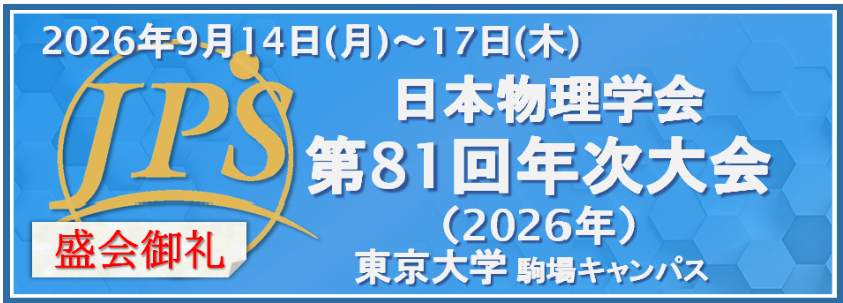
Four Graduate Students Presented Hypernuclear and Strangeness Nuclear Physics Research at the JPS 2026 Annual Meeting
〖学会発表〗日本物理学会 第81回年次大会で大学院生4名がハイパー核・ストレンジネス核物理研究を発表しました
2026年9月14日から17日に東京大学駒場キャンパスで開催された 日本物理学会 第81回年次大会において、 京都大学・滋賀大学ストレンジネス核物理研究グループから 4名の大学院生が研究成果を発表しました。 J-PARC および米国 Jefferson Lab(JLab)という異なる加速器施設で進める ハイパー核・ストレンジネス核物理の研究について、 物理データ解析から次期実験の準備、実験装置開発まで幅広い研究成果を報告しました。
J-PARC と JLab ― 相補的に進めるハイパー核研究
京都大学・滋賀大学ストレンジネス核物理研究グループでは、 日本の J-PARC と米国の Thomas Jefferson National Accelerator Facility(Jefferson Lab; JLab) を主要な研究拠点として、ハイパー核・ストレンジネス核物理の研究を進めています。
J-PARC では π 中間子や K 中間子などのハドロンビームと 高分解能磁気分光器 S-2S を用いた研究を展開しています。 Λハイパー核や Ξハイパー核を生成し、その質量・生成断面積・エネルギー準位などを調べることで、 ストレンジクォークを含むバリオン間相互作用の解明を目指します。
一方 JLab では、高品質の電子線と HES-HKS 分光器系を用いた (e,e′K+) 反応による高精度Λハイパー核分光を進めています。 異なる反応プローブと実験装置を用いる二つの施設で相補的な研究を行うことにより、 ハイパー核の構造とハイペロン–核子相互作用を多角的に明らかにしていきます。
今回の4つの発表は、 「取得済みデータから物理を取り出す」「次の実験を立ち上げる」「新しい実験装置を設計・開発する」 という、実験核物理研究の異なるフェーズを横断しています。 それぞれの大学院生が国際共同実験の主要メンバーとして研究を主体的に進めています。
グループからの研究発表
大学院生が担う、実験核物理のさまざまなフェーズ
大型加速器を用いた実験核物理研究は、ビームタイムでデータを取得する瞬間だけで完結するものではありません。 一つの物理成果を生み出すまでには、実験アイディアの形成、装置設計・製作、インストール、 シミュレーション、データ収集、較正、解析、そして最終的な物理量の抽出まで、 長い研究プロセスがあります。
今回発表した大学院生たちは、それぞれ異なる研究段階に携わりながら、 国内外の共同研究者と議論し、自らの研究テーマを国際共同実験の中で発展させています。 実験装置を「使う」だけではなく、自ら設計・製作し、 取得したデータを自ら解析して物理成果につなげることは、 私たちのグループにおける実験研究・大学院教育の重要な特徴の一つです。
ハイパー核・ストレンジネス核物理を一緒に研究しませんか?
京都大学・滋賀大学ストレンジネス核物理研究グループでは、 J-PARC および米国 Jefferson Lab を舞台とする国際共同研究を進めています。 ハイパー核分光、検出器・標的開発、シミュレーション、データ解析、 分光器光学、物理解析など、修士論文・博士論文につながる多様な研究テーマがあります。
大学院生が研究チームの主要メンバーとして主体的に研究を進めることを重視しています。 学生、研究者、スタッフの方々との大学・研究所の枠を越えた共同研究も歓迎しています。 興味をお持ちの方は、ぜひお気軽に後神までご連絡ください。
関連リンク
English Summary
Four graduate students from the Kyoto University and Shiga University Strangeness Nuclear Physics Group presented their research at the 81st Annual Meeting of the Physical Society of Japan, held at the Komaba Campus of the University of Tokyo from September 14 to 17, 2026.
Our group is pursuing complementary frontier research at two major accelerator facilities: J-PARC in Japan and Thomas Jefferson National Accelerator Facility (Jefferson Lab) in the United States. At J-PARC, hadron beams and the high-resolution S-2S magnetic spectrometer are used to investigate Lambda and Xi hypernuclei and baryon-baryon interactions involving strangeness. At Jefferson Lab, high-quality electron beams and the HES-HKS spectrometer system are being prepared for precision Lambda-hypernuclear spectroscopy using the (e,e′K+) reaction.
Kengo Ebata (D3) presented a measurement of the production cross section of 12ΛC using 1.60 and 1.82 GeV/c pion beams at J-PARC. His work represents the physics-analysis phase of experimental nuclear physics, extracting quantitative information on hypernuclear production from experimental data.
Tomohiro Taniguchi (D1) reported on preparations for J-PARC E94, a high-resolution spectroscopy experiment of Lambda hypernuclei designed to investigate, among other topics, charge symmetry breaking in Lambda-nucleon interactions.
Teppei Iwamoto (D2) presented an overview and preparation status of J-PARC E75-1, which will investigate Xi-hypernuclear production through the (K−,K+) reaction. Xi hypernuclei provide a unique laboratory for extending our understanding of nuclear forces toward more general baryon-baryon interactions involving strangeness.
Kei Ishido (M2) presented the development of a solid target system for future precision hypernuclear spectroscopy at Jefferson Lab, with particular emphasis on a mass-calibration method based on the geometrical arrangement of targets. This work is part of the hardware and experimental-design effort required to achieve high-precision missing-mass spectroscopy.
These four presentations highlight different stages of modern experimental nuclear physics: extracting physics from acquired data, preparing upcoming experiments, and designing and developing new experimental apparatus. Our graduate students participate as active members of international collaborations and take substantial responsibility for these research activities.
Our group welcomes students and researchers interested in hypernuclear physics, strangeness nuclear physics, detector and target development, simulations, data analysis, and international accelerator experiments. Through research at both J-PARC and Jefferson Lab, we aim to explore the fundamental interactions among baryons and their connection to nuclear and hadron physics at the frontier.
関連記事
-
 2026.09.18ニュース〖招待講演〗後神が国際会議 NuSym26 にて JLab ハイパー核分光研究について講演しました (Invited Talk on High-Precision Lambda-Hypernuclear Spectroscopy at NuSym26)
 -
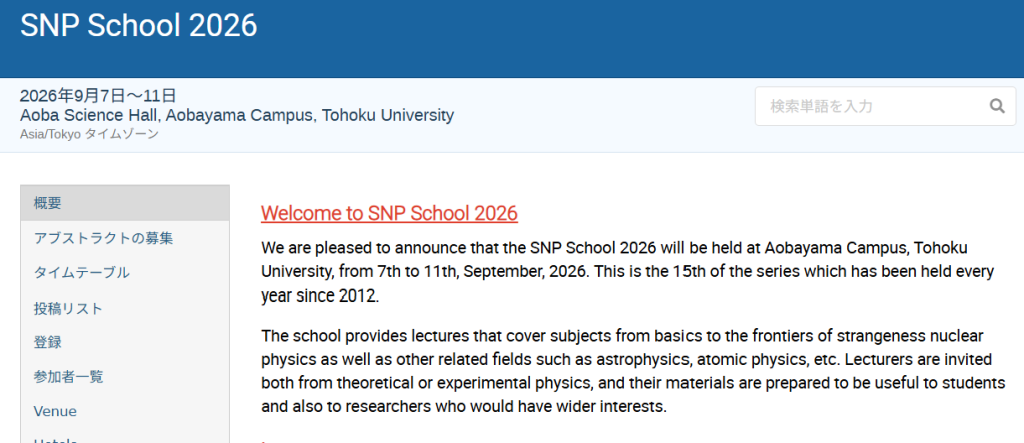 2026.09.11ニュース〖国際スクール〗SNP School 2026 に本グループの大学院生5名が参加しました (Graduate Students Participated in the Strangeness Nuclear Physics School 2026 at Tohoku University)
 -
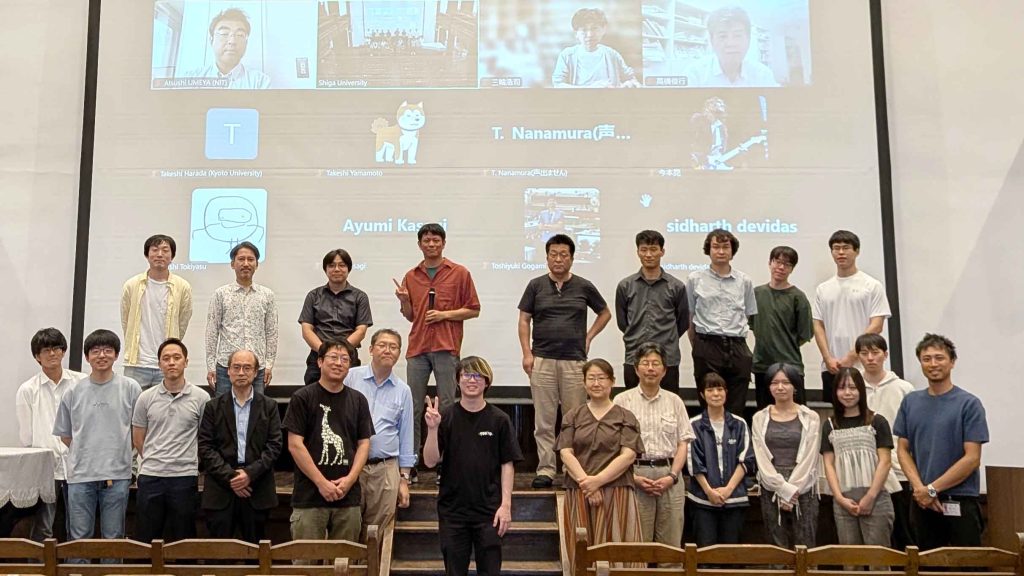 2026.08.07ニュース〖研究会開催報告〗J-PARC S-2S Workshop 2026: Frontiers in Nuclear Strangeness を開催しました (J-PARC S-2S Workshop 2026: Frontiers in Nuclear Strangeness Successfully Held)
 -
 2026.06.23ニュース〖研究会案内〗J-PARC S-2S Workshop 2026: Frontiers in Nuclear Strangeness を開催します (J-PARC S-2S Workshop 2026: Frontiers in Nuclear Strangeness to Be Held)

