
News & Researchニュース & 最新の研究
【研究・検出器開発】J-PARC E94実験に向けたアクリルチェレンコフ検出器の量産を開始しました ([Detector Development] Mass Production of Acrylic Cherenkov Detectors for the J-PARC E94 Experiment Has Started)
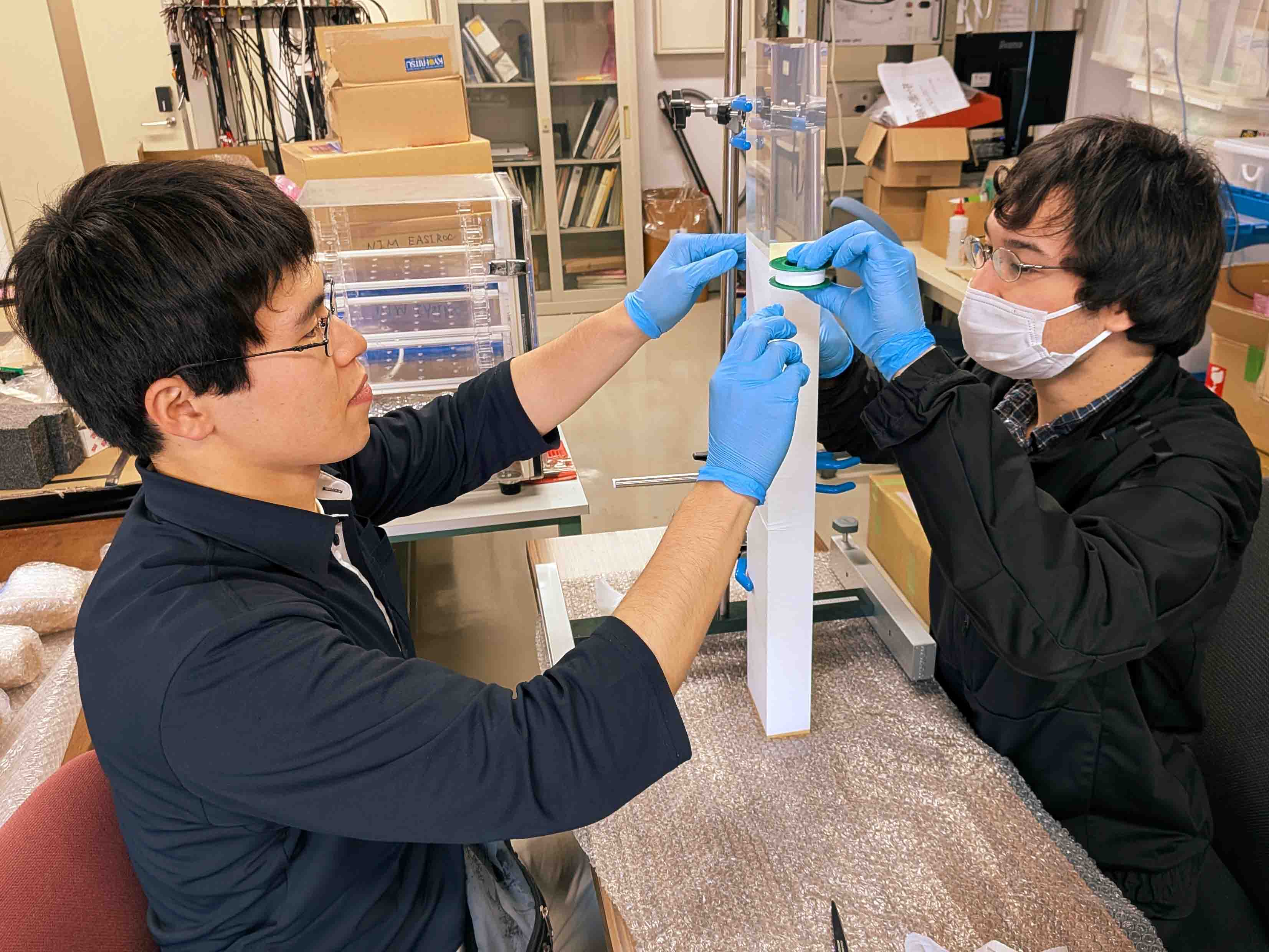
Mass Production of Acrylic Cherenkov Detectors for the J-PARC E94 Experiment Has Started
〖研究・検出器開発〗J-PARC E94実験に向けたアクリルチェレンコフ検出器の量産を開始しました
私たちのグループは、核子間相互作用を、ストレンジネスクォークを含む粒子へと拡張した ハイペロン–核子相互作用・ハイペロン–ハイペロン相互作用の理解を目指し、 実験研究を推進しています。J-PARC E94実験では、A = 7, 10, 12 系のラムダハイパー核を精密に測定し、 ラムダ–核子相互作用における長年の課題である 荷電対称性の破れ(Charge Symmetry Breaking; CSB)の解明に挑みます。
J-PARC E94実験とCSBの謎
通常の原子核は陽子と中性子、すなわち核子から構成されています。一方、ラムダハイパー核は、 そこにストレンジネスクォークを含むラムダ粒子が加わった原子核です。 ラムダ粒子を原子核中に入れることで、通常の原子核だけでは見えにくいバリオン間相互作用の性質を調べることができます。
特に、ラムダ–陽子相互作用とラムダ–中性子相互作用に差があるのか、すなわち ラムダ–核子相互作用における荷電対称性の破れは、 ハイパー核物理における重要な未解決問題の一つです。 J-PARC E94実験では、A = 7, 10, 12 系ラムダハイパー核の高精度分光を通じて、 この問題に実験的に迫ります。
新しい高分解能磁気分光器 S-2S
J-PARC K1.8ビームラインでは、2025年より、京都大学グループが主導して建設した 新しい高分解能磁気分光器 S-2S の運用が開始され、 物理データ取得が始まっています。 E94実験では、このS-2Sを用いることで、従来では到達が難しかった分解能・精度で ラムダハイパー核の欠損質量分光を行います。
本実験では、(π+, K+) 反応を用いてラムダハイパー核を生成し、 生成されたK中間子をS-2Sで測定します。 しかし、ラムダハイパー核の生成事象は非常に稀であり、 陽子、π中間子、ビーム粒子の崩壊に由来するミュー粒子など、 多量のバックグラウンド粒子の中からK中間子を高い純度で識別する必要があります。
そこで私たちは、紫外線透過アクリルを輻射体とする アクリルチェレンコフ検出器をS-2S検出器系に新たに導入し、 K中間子識別能力を向上させることで、ラムダハイパー核の高精度分光を実現する計画です。
アクリルチェレンコフ検出器の量産開始
2026年5月13日、東北大学大学院理学研究科 D3・渡辺大護氏とともに、 京都大学大学院理学研究科 D1・谷口智大氏が京都大学において、 J-PARC E94実験に向けたアクリルチェレンコフ検出器の量産を開始しました。
本検出器は、昨年度、谷口氏が修士論文研究として試作機を製作し、 性能試験を行ったものです。その試験結果に基づき、実機に用いる検出器構成や運用条件を決定しました。 今回の量産開始は、試作・性能評価の段階から、実験装置としてS-2Sへ組み込む段階へ進む重要なステップです。
今後の予定
- 2026年5月: 京都大学にてアクリルチェレンコフ検出器の量産を開始。
- 2026年夏まで: 必要な検出器を全数製作し、実験導入に向けた準備を進める予定。
- 2026年秋: J-PARCハドロン実験施設 K1.8ビームラインにおいて、S-2S検出器系へのインストール準備を整える計画。
English Summary
Our group is experimentally investigating baryon–baryon interactions beyond the ordinary nucleon–nucleon sector, extending them to systems that include strange quarks, such as hyperon–nucleon and hyperon–hyperon interactions. The J-PARC E94 experiment aims to perform high-precision spectroscopy of A = 7, 10, and 12 Lambda hypernuclei in order to address one of the long-standing questions in Lambda–nucleon interaction studies: charge symmetry breaking, namely the possible difference between Lambda–proton and Lambda–neutron interactions.
At the J-PARC K1.8 beamline, the new high-resolution magnetic spectrometer S-2S, constructed under the leadership of the Kyoto University group, started operation in 2025 and has begun taking physics data. The E94 experiment will use this state-of-the-art spectrometer to approach the long-standing CSB problem with a level of precision that was previously difficult to achieve.
In this experiment, Lambda hypernuclei are produced via the (π+, K+) reaction and measured by missing-mass spectroscopy. Since Lambda-hypernuclear production events are extremely rare, efficient and clean identification of K mesons in S-2S is essential. Background particles such as protons, pions, and muons from beam-particle decays must be rejected with high efficiency.
To improve K-meson purification, we are introducing new acrylic Cherenkov detectors using ultraviolet-transmitting acrylic radiators into the existing S-2S detector system. On May 13, 2026, Tomohiro Taniguchi, a D1 student at Kyoto University, together with Daigo Watanabe, a D3 student at Tohoku University, started mass production of the acrylic Cherenkov detectors at Kyoto University.
The detector design is based on prototype studies and performance tests carried out by Taniguchi as part of his master’s thesis research in the previous academic year. We plan to complete the full detector production by this summer and prepare for installation at the K1.8 beamline in the J-PARC Hadron Experimental Facility this autumn.
関連記事
-
 2026.06.17ニュース〖研究会発表〗学術変革(A) 公募研究会にて S-2S による精密ハイパー核分光研究について発表しました (Presentation on Precision Hypernuclear Spectroscopy with S-2S at the Transformative Research Area (A) Workshop)
 -
 2026.06.12ニュース〖国際共同実験〗JLab ハイパー核実験の Experimental Readiness Review が行われました (Hypernuclear Experimental Readiness Review Held at Jefferson Lab)
 -
![【開催報告】2025年度 NHレビューにて1年の研究成果をご報告 & 活動レポート公開 ([Report] KS Group Members Present Annual Achievements at NH Review 2025)](https://www-nh.scphys.kyoto-u.ac.jp/KSgroup/wp-content/uploads/2026/04/nh_review2025-1024x378.png) 2026.03.20ニュース【開催報告】2025年度 NHレビューにて1年の研究成果をご報告 & 活動レポート公開 ([Report] KS Group Members Present Annual Achievements at NH Review 2025)
2026.03.20ニュース【開催報告】2025年度 NHレビューにて1年の研究成果をご報告 & 活動レポート公開 ([Report] KS Group Members Present Annual Achievements at NH Review 2025) -
![【論文公表】岩本(D1)によるJLab実験用データ取得トリガーの研究がHADRON2025プロシーディングに出版されました ([Publication] D1 Iwamoto’s research on DAQ trigger for JLab hypernuclear experiments published in PoS(HADRON2025))](https://www-nh.scphys.kyoto-u.ac.jp/KSgroup/wp-content/uploads/2026/01/PoS_Iwamoto2026-1024x811.jpg) 2026.02.20会議抄録【論文公表】岩本(D1)によるJLab実験用データ取得トリガーの研究がHADRON2025プロシーディングに出版されました ([Publication] D1 Iwamoto’s research on DAQ trigger for JLab hypernuclear experiments published in PoS(HADRON2025))
2026.02.20会議抄録【論文公表】岩本(D1)によるJLab実験用データ取得トリガーの研究がHADRON2025プロシーディングに出版されました ([Publication] D1 Iwamoto’s research on DAQ trigger for JLab hypernuclear experiments published in PoS(HADRON2025))

