
News & Researchニュース & 最新の研究
〖国際共同実験〗JLab ハイパー核実験の Experimental Readiness Review が行われました (Hypernuclear Experimental Readiness Review Held at Jefferson Lab)
Hypernuclear Experimental Readiness Review Held at Jefferson Lab
〖国際共同実験〗JLab ハイパー核実験の Experimental Readiness Review が行われました
2026年6月4日から5日にかけて、米国 Jefferson Lab(JLab)において、 Hypernuclear Experimental Readiness Review(ERR) が開催されました。 本レビューでは、JLab Hall C におけるハイパー核実験の実施に向けて、 実験装置、ビームライン、検出器、解析・シミュレーション、安全、運転計画など、 技術面および安全面を中心とした準備状況が確認されました。
実験実施に向けた準備状況のレビュー
Experimental Readiness Review は、加速器実験を安全かつ確実に実施するために、 実験装置・運転計画・安全文書・人員体制・解析準備などを多角的に確認する重要なプロセスです。 今回のレビューでは、JLab Hall C におけるハイパー核実験について、 前回のレビュー以降に明確になった課題への対応状況も含めて、 実験開始に向けた準備の進捗が議論されました。
レビューアーからは、今後の実験実施に向けたコメントおよび recommendation が示されました。 それらは今後の最終準備に反映していく必要がありますが、 実験グループとしては、今回のレビューを通じて、技術面・安全面の準備が着実に進んでいることを確認し、 ERR プロセスにおける大きな節目を迎えることができました。
今回のレビューにより、ハイパー核実験は実験施行に向けて一段階進んだフェーズに入りました。 今後は、レビューで示されたコメントと recommendation に対応しながら、 実験装置の最終調整、検出器の健全性確認、コミッショニング計画の具体化を進めていきます。
検出器準備の進展
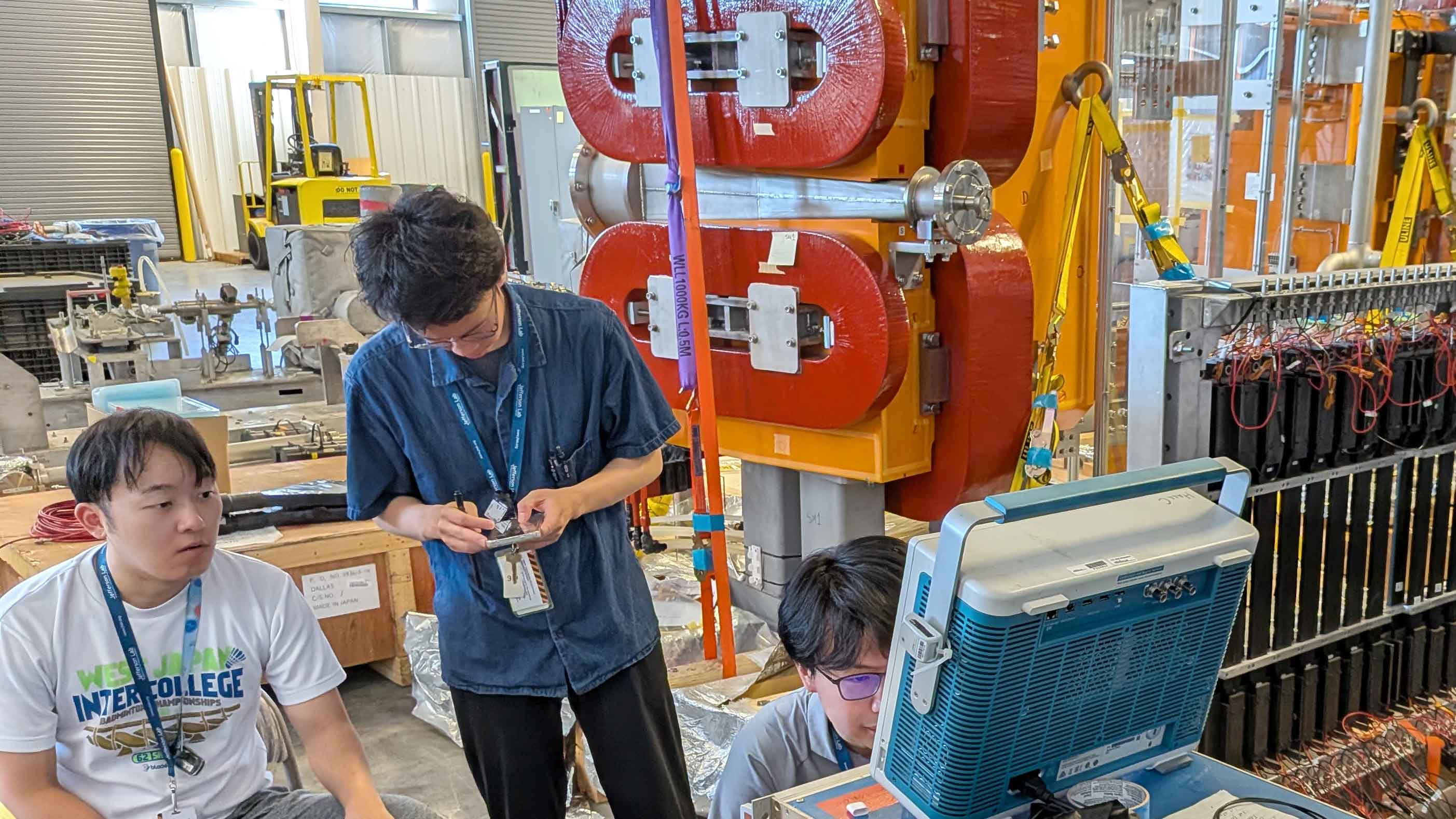
ERR と並行して、現地では実験検出器の準備作業も進められました。 写真は、磁気分光器 HES に用いられる粒子飛行時間測定用のプラスチックシンチレーション検出器について、 光漏れがないことを確認し、検出器としての基本的な健全性を評価している場面です。
また、シンチレーション検出器に取り付けられる光電子増倍管(PMT)からの信号を、 ベータ線源を用いて確認しました。 このような一つ一つの検出器確認は、ハイパー核分光実験において高精度な飛行時間測定を実現するための 重要な準備作業です。
ハイパー核実験の物理的意義
ハイパー核は、通常の原子核にラムダ粒子などのハイペロンが加わった原子核です。 その精密分光を行うことで、ストレンジネスクォークを含むバリオン間相互作用、 すなわちハイペロン–核子相互作用に関する情報を得ることができます。
これらの相互作用は、原子核物理・ハドロン物理だけでなく、 中性子星内部の高密度物質を理解するうえでも重要です。 JLab における電子線を用いたハイパー核実験は、 高分解能なハイパー核分光を通じて、この分野に新しい実験的知見を与えることを目指しています。
大学院生・若手研究者の参加を歓迎します
本実験には、検出器開発、読み出し回路、データ収集、解析ソフトウェア、シミュレーション、 光学解析、物理解析など、修士論文・博士論文のテーマとなり得る多様な研究課題があります。 国内外の大学院生の参加を歓迎しています。
また、スタッフ・研究者の方々との多様な形での共同研究も随時歓迎しています。 興味をお持ちの方は、いつでも後神までご連絡ください。
関連リンク
Hypernuclear ERR の詳細は、Jefferson Lab の公開ページをご覧ください。
English Summary
The Hypernuclear Experimental Readiness Review (ERR) was held at Jefferson Lab on June 4–5, 2026. The review focused on the technical and safety readiness of the Hall C hypernuclear experiments, including the experimental apparatus, beamline, detector systems, analysis and simulation framework, safety documentation, manpower, and plans toward experiment execution.
The review committee provided comments and recommendations that will be incorporated into the final preparation phase. While formal follow-up procedures and documentation will continue, the review marked an important milestone for the collaboration: the preparation of the experiment has advanced to the next stage toward execution.
In parallel with the ERR, detector preparation work was carried out on site. The photo shows Ishido, an M2 graduate student at Kyoto University, together with Nishi, a D2 graduate student at the University of Tokyo, and Takahashi, an M2 graduate student at the University of Tokyo, checking the light tightness of plastic scintillation detectors for time-of-flight measurements in the High-Resolution Electron Spectrometer (HES). They also tested signals from photomultiplier tubes (PMTs) attached to the detectors using a beta source.
The JLab hypernuclear experiments aim to perform high-resolution spectroscopy of hypernuclei and to provide experimental information on hyperon–nucleon interactions. These studies are important not only for nuclear and hadron physics, but also for understanding dense matter in neutron stars.
We welcome participation from graduate students in Japan and abroad. The project offers a wide range of possible master’s and doctoral research topics, including detector hardware, readout electronics, data acquisition, analysis software, simulations, spectrometer optics, and physics analysis. We also welcome collaborations with researchers and staff members in various forms. Please feel free to contact Toshiyuki Gogami if you are interested.
関連記事
-
 2026.09.18ニュース〖招待講演〗後神が国際会議 NuSym26 にて JLab ハイパー核分光研究について講演しました (Invited Talk on High-Precision Lambda-Hypernuclear Spectroscopy at NuSym26)
 -
 2026.09.17ニュース〖学会発表〗日本物理学会 第81回年次大会で大学院生4名がハイパー核・ストレンジネス核物理研究を発表しました (Four Graduate Students Presented Hypernuclear and Strangeness Nuclear Physics Research at the JPS 2026 Annual Meeting)
 -
 2026.09.11ニュース〖国際スクール〗SNP School 2026 に本グループの大学院生5名が参加しました (Graduate Students Participated in the Strangeness Nuclear Physics School 2026 at Tohoku University)
 -
 2026.08.07ニュース〖研究会開催報告〗J-PARC S-2S Workshop 2026: Frontiers in Nuclear Strangeness を開催しました (J-PARC S-2S Workshop 2026: Frontiers in Nuclear Strangeness Successfully Held)

