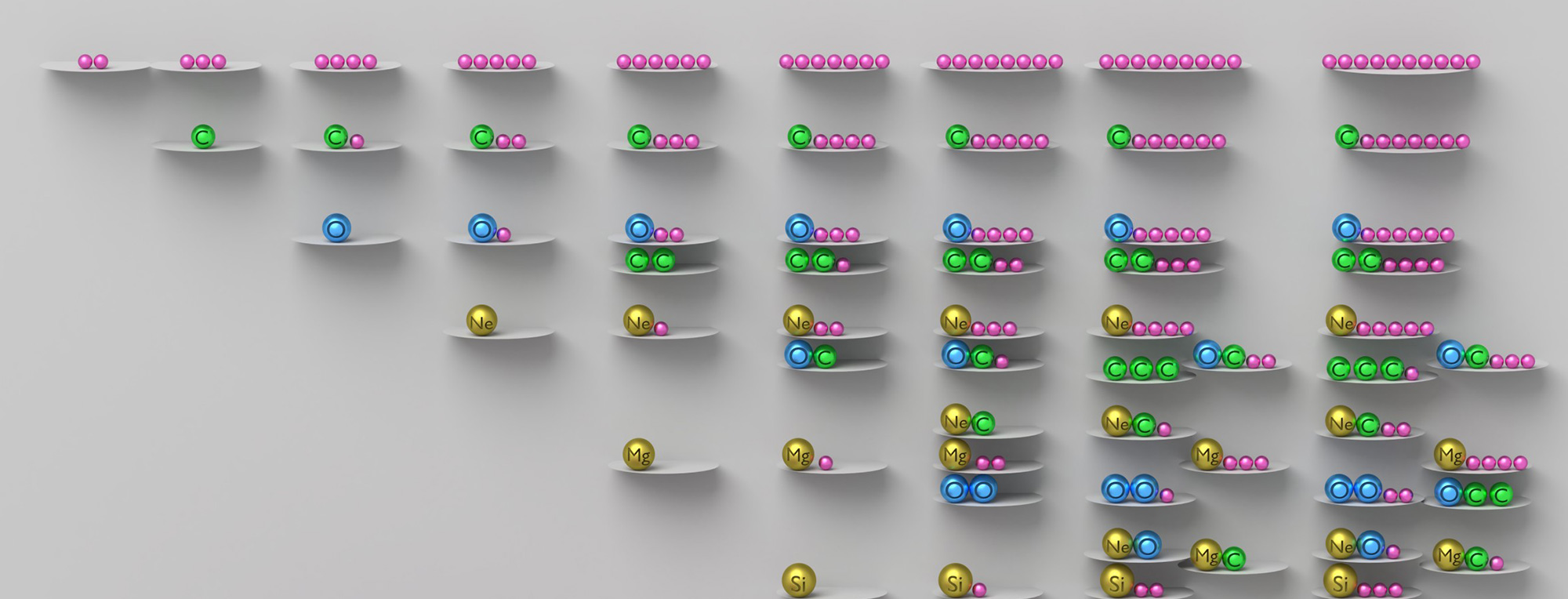
Unlocking the Universe
with Strangeness
From Quarks to Neutron Stars.
What is Strangeness?
Everything around us is made of atoms, which consist of electrons and a nucleus. The nucleus is composed of protons and neutrons, which are built from two types of quarks: Up (u) and Down (d).
However, nature holds a third type of quark: the Strange (s) quark. When a particle containing an s-quark (a hyperon) is embedded into a nucleus, it forms a "Hypernucleus". By creating these hypernuclei in the laboratory, we can explore the deep mysteries of nuclear forces and the origin of matter, which are invisible in our ordinary world.
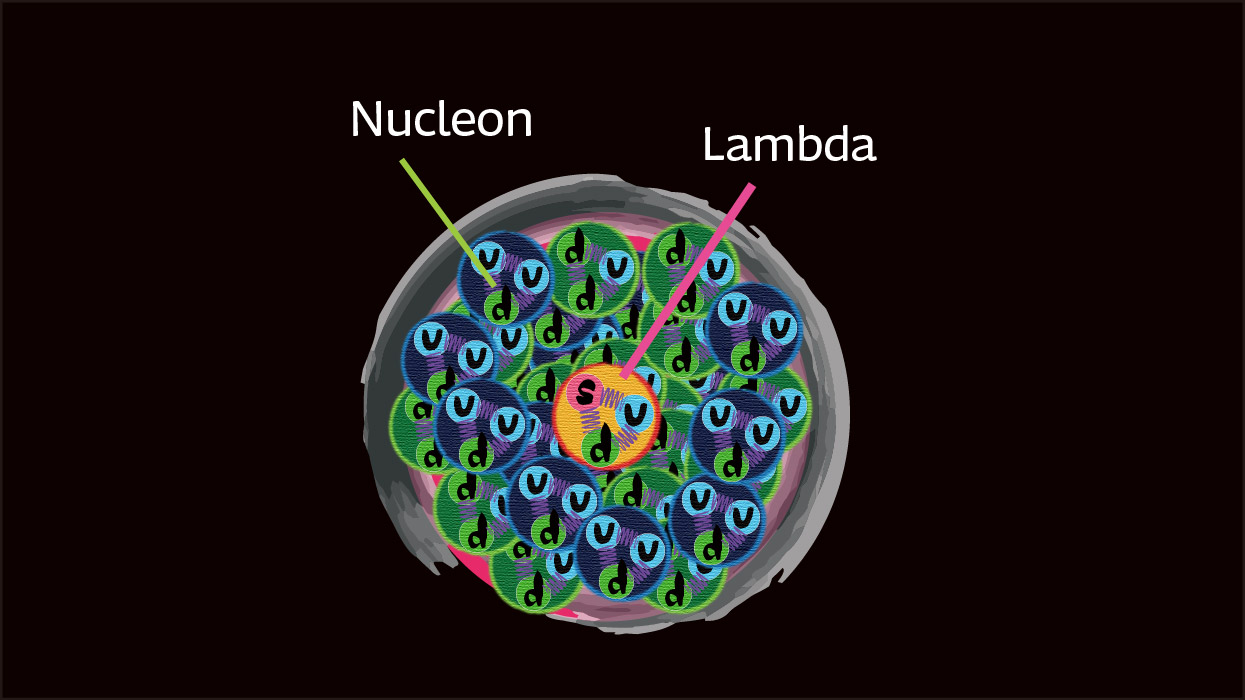 Fig: A Hypernucleus containing a Lambda particle (with an s-quark).
From Micro to Macro
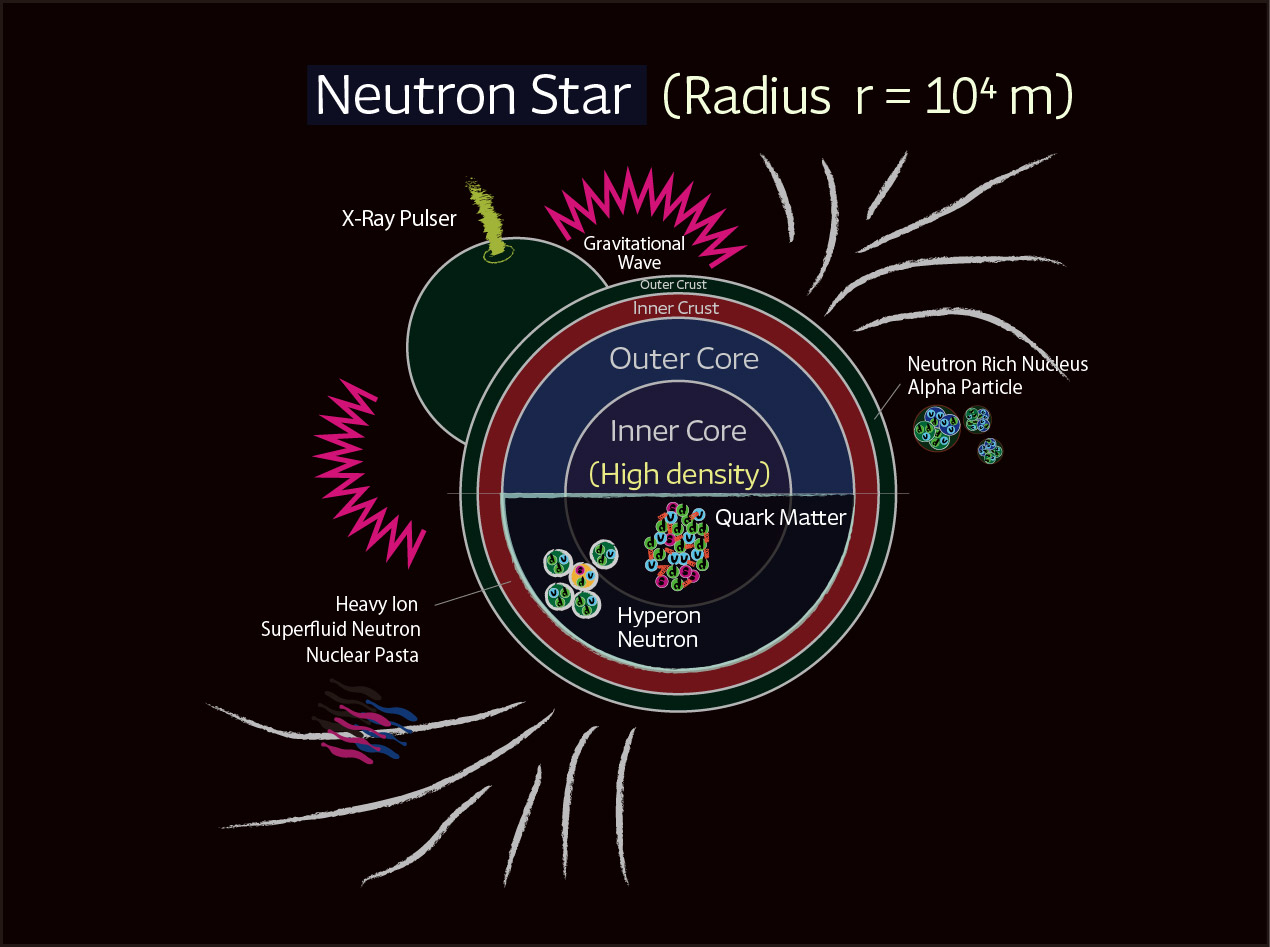
Hypernuclear physics is not just about the microscopic world. It is the key to understanding the Neutron Stars—giant laboratories in the universe.
Neutron stars, the remnants of massive stars, possess ultra-high density cores where hyperons are believed to exist. By precisely measuring the interactions between particles in hypernuclei on Earth, we aim to unravel the internal structure of neutron stars. This research is a hot topic in modern physics, closely linked with gravitational wave astronomy.
Two Frontiers
We conduct research at two of the world's leading accelerator facilities in the US and Japan.
Our strengths lie in "The world's highest precision electron beam" and "The world's highest intensity hadron beam."
Precision Spectroscopy with Electron Beams
Using the high-quality electron beam at Thomas Jefferson National Accelerator Facility (JLab), we measure the mass of hypernuclei with ultimate precision. We have independently developed high-resolution magnetic spectrometers (HES/HKS) and are leading international collaborations.
Key Projects:
Solving the Hypertriton Puzzle (E12-19-002)
Verification of Charge Symmetry Breaking (CSB)
New Frontiers with Hadron Beams
At the J-PARC high-intensity proton accelerator facility in Ibaraki, Japan, we explore "Double Strangeness Systems" (such as Ξ-hypernuclei) containing two strange quarks. We have constructed the new S-2S spectrometer to challenge uncharted territories.
Key Projects:
Missing-mass spectroscopy of Ξ-hypernuclei (E70)
CSB study in p-shell hypernuclei (E94)
Global & Active Research
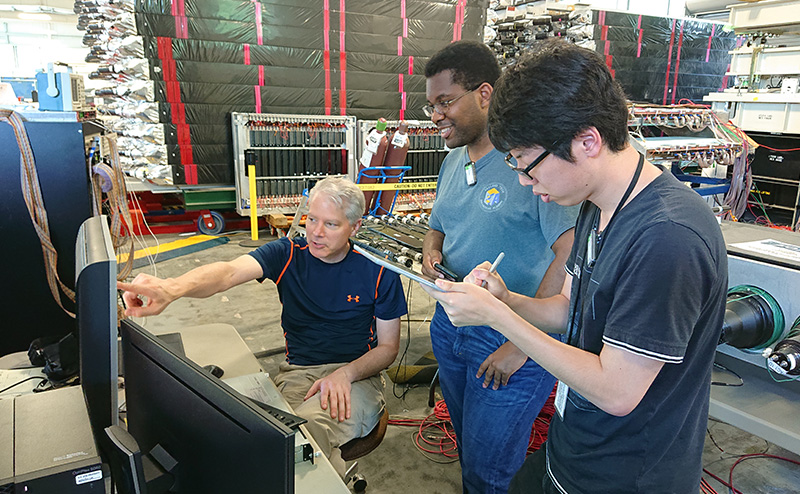
Our research group promotes international collaborations led by students.
Experimental shifts at JLab, detector development, and discussions with overseas researchers.
This environment allows you to acquire practical skills to succeed globally while touching the forefront of physics.
We welcome students with a passion for conducting experiments abroad and operating large-scale apparatus.
Q&A for International Students/Postdocs
Yes, absolutely! The Kyoto University International Office (KUISO) provides extensive support for housing, visas, and daily life. You can focus on your research with peace of mind.
Research meetings and discussions can be conducted in English. Since most of our members are involved in international collaborations, daily communication in English is perfectly fine. We welcome diverse backgrounds!
We actively recruit talented students and postdocs. You will have opportunities to lead projects at JLab and J-PARC. Please contact us if you are interested in joining our quest to unlock the universe!
Contact

Join Our Quest
For the latest news, publications, and member information,
please visit our group website.